
AI Agents vs AI Workflows: Choosing the Right Automation
Discover the differences between autonomous AI agents and scripted workflows and learn how to use each for faster, smarter document processing.

Ethan van der Maarel
Dec 29, 2025
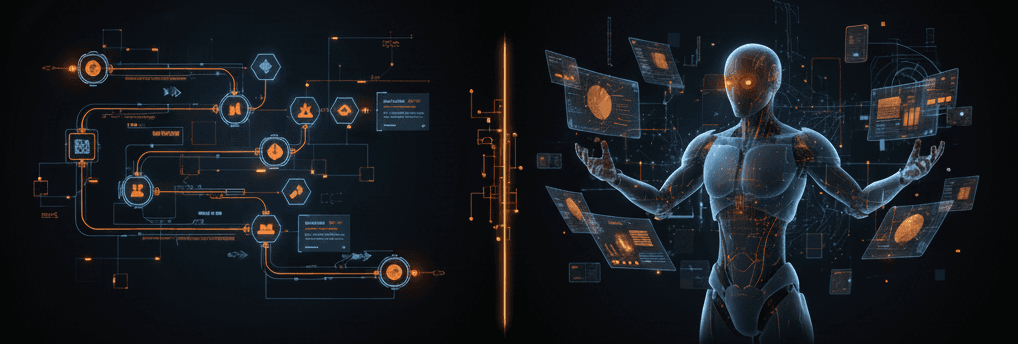
Imagine automation that doesn’t just follow a set of rules. Instead, it thinks, adapts, and decides the best way to get the job done, even when the data is incomplete or the situation is unexpected.
That’s the difference between a traditional AI Workflow and an autonomous AI Agent.
For years, businesses have relied on workflows: predictable sequences triggered by specific events. They are effective at moving data from point A to point B. However, when a process requires judgment, validation, or the ability to respond to changes, workflows reach their limit.
AI Agents move beyond that limit. They understand context, plan multiple steps, solve problems in real time, and learn from experience. In the field of Intelligent Document Processing, this capability transforms operations from invoice validation and fraud detection to contract review and HR onboarding.
In this article, we’ll explore:
The difference between AI Agents and AI Workflows
When to use each
Real-world examples from finance, legal, HR, and compliance
How to start implementing agents in your business
Key Takeaways
AI Workflows: Best for repetitive, predictable tasks with fixed structures.
AI Agents: Designed for complex processes requiring autonomy, context awareness, and adaptability.
In Intelligent Document Processing, agents improve speed, accuracy, and compliance by handling exceptions without manual intervention.
Gartner predicts that by 2026, 40% of enterprise applications will incorporate task-specific AI agents.
The most effective automation strategies combine workflows for routine processes with AI Agents for decision-intensive tasks.
Deploying the right AI Agent starts with mapping processes, identifying high-impact areas, and integrating systems for seamless data flow.
What Are AI Workflows?
An AI Workflow is a structured sequence of automated steps designed to perform a task when specific triggers or conditions are met. These workflows follow predefined rules and are most effective in situations where the process is predictable and consistent.
AI Workflows excel in environments where tasks always follow the same pattern. They are ideal for routine data transfers, scheduled reporting, and step-by-step actions that do not require complex decision-making.
Key characteristics of AI Workflows:
Fixed sequence of actions
Triggered by a specific event or input
Suited for repetitive and predictable tasks
Limited ability to adapt to unexpected changes
Example in Intelligent Document Processing: A workflow may capture incoming invoices, extract standard fields such as supplier name and total amount, and automatically store each file in the correct digital folder within an ERP system. If the invoice is missing a required field, the workflow halts until a human reviews and corrects the data.
What Are AI Agents?
An AI Agent is an autonomous system designed to complete tasks by understanding context, making decisions, and adapting to changing circumstances. Unlike workflows, which follow a fixed path, AI Agents can modify their approach in real time based on the data they receive or the conditions they detect.
AI Agents do not simply process information. They evaluate it, identify the next best step, and execute multiple actions without requiring constant human supervision. Some are highly specialised, focusing on a single domain such as contract management or fraud detection, while others work across multiple processes.
Key characteristics of AI Agents:
Autonomous decision making
Ability to adapt workflows based on context
Multi-step problem solving
Continuous improvement through learning
Capability to work across varied document types and formats
Example in Intelligent Document Processing: An Invoice Processing Agent receives an invoice from an email, extracts data, validates amounts against purchase orders, checks for potential fraud, and routes it to the approval queue. If certain fields are missing, the agent can request the missing data, cross-check with other documents, or flag the issue for human review without halting the entire process.
Key Differences Between AI Agents and AI Workflows
Although AI Agents and AI Workflows are both used to automate processes, they operate in fundamentally different ways. Understanding their distinctions is essential for choosing the right approach for each task.
Feature | AI Workflows | AI Agents |
|---|---|---|
Structure | Fixed series of predefined steps | Flexible approach with adaptive responses |
Decision Making | Follows rules exactly as defined | Uses context to decide the next action |
Handling of Variations | Stops when inputs or conditions do not match expectations | Adjusts process flow when faced with unexpected data or events |
Complexity | Best for repetitive, predictable tasks | Designed for complex, multi-step processes |
Learning Ability | Does not learn from past tasks | Learns and improves over time based on new data |
Supervision Needs | Human intervention is required for exceptions | Minimal supervision needed for most tasks |
Practical interpretation:
Use AI Workflows when the process is stable and does not require decision-making, such as archiving invoices in a standard format.
Use AI Agents when the process involves multiple decision points, exceptions, data validation, or fraud detection, such as processing contracts with varying formats and terms.
Capabilities of Modern AI Agents
Modern AI Agents are not simply programmed to carry out a series of steps. They combine advanced perception, decision-making, and execution abilities to manage tasks end-to-end with minimal human involvement.
1. Context Awareness
AI Agents can interpret the meaning and purpose of the data they handle.
Example: A Contract Management Agent recognises that missing signature fields or altered document dates are critical issues and can escalate or correct them automatically.
2. Adaptive Decision Making
AI Agents select the most appropriate action based on real-time inputs rather than solely following a pre-set path.
Example: An Invoice Processing Agent detects that an invoice total does not match the purchase order and initiates a reconciliation process.
3. Multi-Step Task Execution
Instead of stopping at one action, an AI Agent can chain together multiple capabilities.
Example: An HR Onboarding Agent extracts CV data, verifies identification documents, anonymises sensitive information, and updates HR systems in one sequence.
4. Advanced Problem Solving
AI Agents can address exceptions and anomalies rather than halting operations.
Example: A Fraud Detection Agent identifies irregular metadata in a document and automatically routes it for deeper inspection.
5. Continuous Learning
Using feedback from past actions, AI Agents refine their methods and increase accuracy over time.
Example: A Data Extraction Agent learns how to better identify fields in complex documents by adjusting its recognition model after processing new formats.
These capabilities allow agents to handle far more complexity than workflows, making them suitable for varied industries and advanced automation needs.
Real-World Applications by Industry
AI Agents are applied across industries to automate complex processes and improve speed, accuracy, and compliance.
Below, we've listed some of the most common use cases, connected directly to the agents available on idpagents.com.
Finance and Compliance
AP Automation Agent: Captures invoice data, validates amounts against purchase orders, checks tax compliance, and pushes approved entries directly to ERP systems.
Fraud Detection Agent: Scans documents for signs of manipulation by analysing metadata, image files, and historical patterns.
KYC Verification Agent: Automates identity checks and document verification for onboarding customers or suppliers.
Human Resources
HR Onboarding Agent: Extracts CV details, verifies identification documents from over 150 countries, and uploads clean, structured data to HR platforms.
Data Anonymization Agent: Removes sensitive personal information from HR documents to comply with privacy laws such as GDPR.
Legal and Contracts
Contract Management Agent: Identifies key clauses, dates, and obligations, flags inconsistencies, and schedules reviews before contract deadlines.
Document Classification Agent: Automatically sorts and labels legal documents based on content for improved search and archiving.
Healthcare
Healthcare Agent: Processes patient records, insurance claims, and medical forms securely while ensuring compliance with regulations like HIPAA.
Document Verification Agent: Confirms the authenticity of medical certificates and diagnostic reports.
Logistics and Manufacturing
Logistics Agent: Extracts and tracks data from shipping manifests, delivery notes, and customs documentation.
Manufacturing Agent: Processes work orders, quality inspection reports, and production records for instant availability.
These examples show how AI Agents move beyond simple process automation, delivering autonomous, adaptable solutions across diverse industries.
When to Use an Agent vs a Workflow
Choosing between an AI Agent and an AI Workflow depends on the nature of the process, the level of decision-making involved, and the need for adaptability.
Use an AI Workflow when:
The process is fixed and follows a consistent pattern
Data formats and inputs are highly predictable
There is little need for context-based decisions
Exceptions can wait for human intervention
Example: Automatically routing standardised invoices to the correct folder in an ERP system.
Use an AI Agent when:
The process contains multiple decision points
Data formats vary or include incomplete information
The process requires validation and cross-checking
Speed and autonomy are priorities
Exceptions must be resolved without halting the process
Example: Processing a mix of domestic and international contracts where an AI Agent extracts clauses, validates terms, detects missing elements, and schedules follow-up actions.
Checklist for deciding:
Does the process require decisions or validation?
Do formats and inputs vary?
Is compliance or fraud detection part of the task?
Will delays from manual intervention cause problems?
Is scalability without adding staff important?
If the answer to several of these questions is "yes", an AI Agent is the more effective choice.
The Future of AI Agents
AI Agents are rapidly becoming a standard part of intelligent automation strategies. As document-heavy industries demand faster, more accurate processing, autonomous systems will continue to replace manual intervention for complex workflows.
Gartner predicts that by 2026, 40 percent of enterprise applications will be integrated with task-specific AI agents, a sharp increase from less than five percent in 2025
For Intelligent Document Processing, this trend signals that most high-value, decision-intensive processes will increasingly rely on AI Agents. Tasks such as data extraction, fraud detection, contract management, and regulatory compliance will be executed not by static workflows, but by agents capable of adapting and resolving exceptions without manual intervention.
Future developments are expected to include:
Greater integration between multiple agents, allowing entire business functions to be automated through coordinated decision-making
Improved learning capabilities, enabling agents to adapt even more quickly to new formats, regulations, and business rules
Expansion into industries with strict compliance requirements, such as healthcare, finance, and government
Increased interoperability, where AI Agents seamlessly connect with ERP, CRM, HR, and legal systems without custom coding
As these capabilities advance, AI Agents will move from specialised tools to essential business components. Workflows will remain valuable for predictable processes, but agents will dominate the area.
Conclusion
AI Workflows remain an effective choice for predictable, repetitive tasks that require minimal variation. They move information efficiently from one step to the next, but stop when something falls outside the predefined rules.
AI Agents offer a different level of capability. They understand context, make decisions, solve problems, and adapt when conditions change. This makes them essential for processes involving complex documents, compliance requirements, fraud detection, or multi-step decision paths.
The future of automation will combine both approaches. Workflows will handle stable processes, while AI Agents will lead in areas where intelligence, flexibility, and autonomy are required.
For organisations aiming to reduce manual intervention, increase accuracy, and scale document processing, selecting the right AI Agent is a direct path to measurable results.
Book a demo with us to see how specialised agents can be deployed in finance, legal, HR, healthcare, logistics, and manufacturing — and identify the one that fits your most pressing business challenges.
FAQ — AI Agents vs AI Workflows
1. What is the main difference between an AI Agent and an AI Workflow?
An AI Workflow follows a fixed sequence of predefined steps triggered by specific conditions. An AI Agent can assess the situation, make decisions, adapt steps in real time, and complete the process autonomously.
2. Can AI Agents replace all workflows?
No. Workflows remain valuable for predictable, stable processes. AI Agents are best suited for tasks that require decision-making, validation, fraud detection, or handling exceptions without stopping.
3. Do AI Agents need human supervision?
Minimal supervision is needed for most tasks. However, agents can be configured to escalate critical exceptions or compliance-related issues to human reviewers.
4. Are AI Agents used in specific industries?
Yes. They are widely deployed in finance, HR, legal, healthcare, manufacturing, and logistics, especially in document-heavy processes.
5. How do I start using AI Agents?
Begin with a high-volume process that has multiple decision points, integrate an AI Agent designed for that task, and monitor its performance before expanding to other areas.